Story ideas
How do you potty train a toddler who is scared of the potty?
How to help a toddler who's scared of the potty by naming the real fear like the loud flush, giving one simple coping tool, and letting them see a hero like them get through it.
The short answer
Lower the stakes and let your toddler rehearse success before they have to perform it: familiarize them with the potty pressure-free, name the specific fear like the loud flush, and give one simple coping tool they can actually do. Let them control the flush and never force a scared child to sit, which deepens the fear. A story where a character just like them feels the same fear and gets through it lets them watch themselves do it first.
Key takeaways
- The potty is loud, the seat is big, and it asks a toddler to be brave about something they don't fully understand.
- Fear runs on a different system than motivation, so sticker charts and pep talks often stall.
- Let a child rehearse success by watching a hero like them go first.
- A story that names the real fear and gives one simple tool helps more than a reward chart.
How do you potty train a toddler who is scared of the potty?
Lower the stakes and let them rehearse success before they have to perform it: familiarize them with the potty pressure-free, name the specific fear, give one simple coping tool, and let a story show a child like them getting through it. If your toddler is scared of the potty, a small body treats it as a safety issue, not a matter of willpower.
A reward chart asks a child to push through fear for a prize. A story lets a child walk around the fear by watching someone safe go first.
Why does a story work when a sticker chart doesn't?
Toddlers learn the world through story and repetition long before logic. Child psychologists call it modeling, and it's the same reason kids try a slide after they see a friend go down it. Now make the "someone" their own name and face, and they watch themselves do it instead of just being told it's okay.
What does a good potty-fear story look like?
The names and characters are invented for this example. In a real personalized book, the hero is your own child.
1. A hero with something big to learn
Mia was three-and-three-quarters, which she will tell you is almost four. She could hop on one foot, pour her own cereal, and name every dinosaur with a spiky tail. But there was one thing Mia did not do: sit on the potty. "Diapers are cozy," she said. And that was that.
2. A worry she can name
The truth was, the potty scared her. It was tall. The seat was cold. And worst of all was the flush: a big, roaring WHOOSH that sounded like it could swallow the whole bathroom, and maybe a small dinosaur expert too. So Mia kept her distance, and her tummy did a nervous little flip every time Mama said the word "potty."
3. A hero who looks just like her
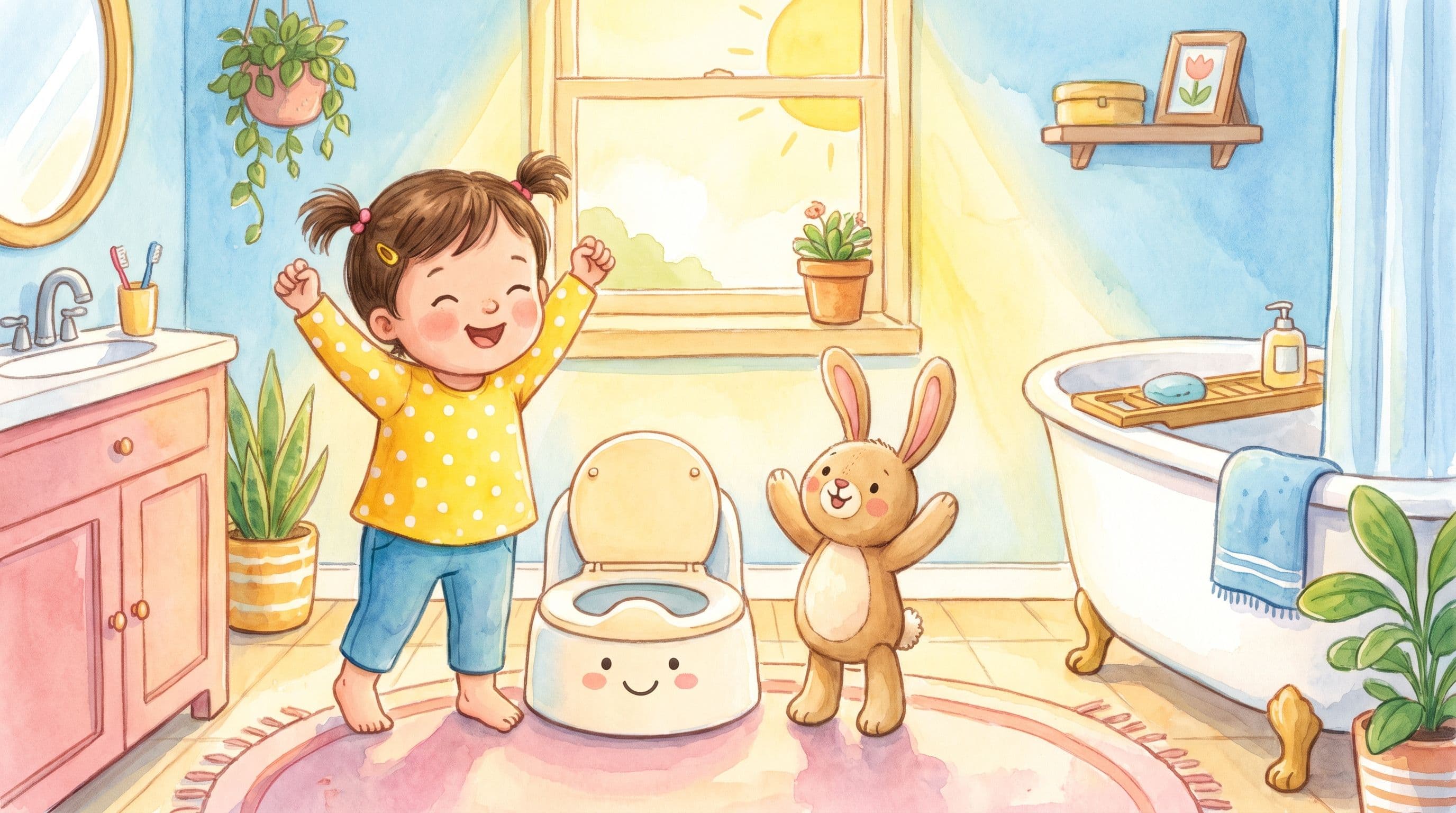
One night, Mama pulled out a brand-new book with a girl on the cover who had Mia's exact pigtails, Mia's yellow polka-dot shirt, and Mia's very own name in shiny letters. In the story, that Mia was scared of the potty too, of the tall seat and the loud WHOOSH. Mia's eyes went wide. "That's me," she whispered. "The loud one scares me too." Beside story-Mia stood a brave stuffed bunny named Captain Cottontail, who had a plan.
4. She tries, and is proud of herself
In the book, Captain Cottontail taught story-Mia the Brave Bunny Trick: take one deep breath, count "one-two-hop," and flush after you leave the room so the WHOOSH says goodbye from far away. Story-Mia tried it. It worked. And real Mia, tucked under her blanket, decided that if story-Mia could do it, so could she. The next morning she marched to the bathroom, took a deep breath, counted "one-two-hop," and sat right down. Nothing swallowed anyone. She beamed. "I did the brave bunny trick," she announced to the entire house.
5. She comes back to the book
That book did not go back on the shelf. Mia asked for it at breakfast, at nap, and three times at bedtime. She read it to Captain Cottontail. Every time she got to the part where story-Mia is brave, real Mia sat up a little taller, because it was the thing she actually did. The potty is still loud. It just doesn't scare her anymore.
How should you use a story like this at home?
- Read it days before you expect any potty success. You're planting the model, not demanding a result.
- Read it the same way every time. Repetition is how the tool sticks.
- Let your child "teach" the trick to a stuffed animal. Explaining it back cements it.
- Keep your own reaction small and warm; a proud, quiet "you did the brave thing" lands better than a big celebration.
Is it normal for a toddler to be scared of the potty?
Completely — fear of the flush, the height of the seat, and the sensation of "letting go" are among the most common reasons potty training stalls, and it's usually a sign of a sensitive, observant kid. The American Academy of Pediatrics notes that some children fear being flushed away or losing a part of themselves, and advises giving them control by letting them flush, talking through what's upsetting them, backing off when they resist rather than forcing it, and praising every small step (Emotional Issues and Potty Training Problems).
Keep reading: bedtime is the next battle for a lot of these same kids — see how the same approach helps a child who's scared of the dark.