Story ideas
How do you get a child to brush their teeth without a fight?
How to end the toothbrushing fight with a young child by making the two minutes a predictable, playful ritual they help own, with a full example story.
The short answer
Make brushing the same fun ritual every time, with a song or timer that fills the two minutes and gives your child a job to own, like choosing the brush and holding it first. Nagging turns brushing into a power struggle a child can win by clamping their mouth shut, so a predictable, playful routine sidesteps the fight. A story where a character just like them enjoys brushing helps that ritual stick.
Key takeaways
- The resistance is often sensory (taste, texture, buzzing) plus being told to hold still.
- Make the two minutes a predictable, playful ritual with a song or timer.
- Give your child a job to own: their own brush, their own song, small choices.
- A story where your child enjoys brushing replaces the power struggle with a routine.
How do you get a child to brush their teeth without a fight?
Make it the same fun ritual every time, with a song or timer that fills the two minutes and gives your child a job to do. For a lot of young kids the toothbrush means a weird texture, a strong taste, and being told to hold still when they'd rather be anywhere else. Twice a day, that becomes a standoff, and more insisting rarely helps.
What helps is making the two minutes predictable, playful, and something your child feels a little ownership over. Nagging turns brushing into a power struggle, and a power struggle is one a toddler will happily win by clamping their mouth shut.
Why does a story work when nagging doesn't?
A story sidesteps the fight entirely. When a child watches a hero have fun brushing, brushing stops being the enemy and starts being a thing that fun kids do. Put your child's name and face on that hero and it becomes their own routine.
What does a good toothbrushing story look like?
The names and characters are invented for this example. In a real personalized book, the hero is your own child.
1. A hero with something big to learn
Emma was great at lots of things. Brushing her teeth was not one of them, mostly because she refused. Every night ended the same way: toothbrush in one hand, Emma's mouth clamped shut, everyone a little grumpy.
2. A worry she can name
The toothpaste felt too spicy, the brush felt too buzzy, and being told to open up when she didn't want to made her want to open up even less. The more she fought, the longer and worse it got for everyone.
3. A hero who looks just like her
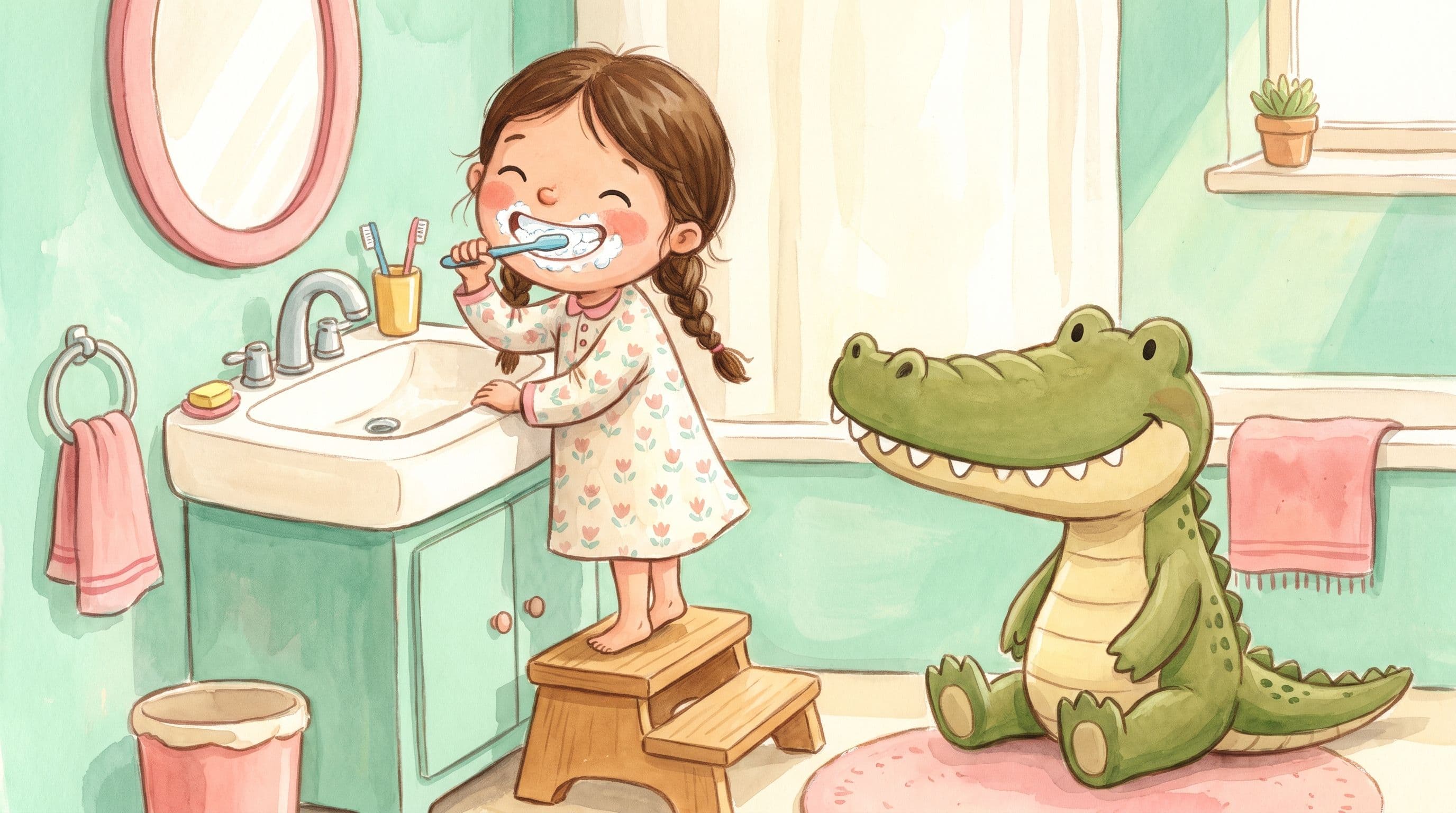
One night Mom read her a new book with a girl on the cover who had Emma's brown braids and Emma's own name on the front. In the story, that Emma hated brushing too, until she met a friendly crocodile named Chompy with the shiniest teeth in the swamp. Chompy's secret was the Crocodile Song, a short silly song you sing while you brush every tooth, top and bottom, front and back, until the song ends and the teeth sparkle.
4. She tries, and feels proud
Story-Emma sang the Crocodile Song and brushed along, and it turned out to be kind of fun. Real Emma wanted to try Chompy's song. She picked her own toothbrush, Mom started the silly song, and Emma brushed each part of her mouth until it finished. She grinned a big foamy crocodile grin in the mirror. Two minutes went by and she barely noticed.
5. She won't stop asking for the book
Emma asked for the book at bedtime and sang the Crocodile Song at the sink morning and night. She showed her clean teeth to anyone who'd look. Brushing stopped being a fight, because now it was a song she got to do, with a crocodile she wanted to match.
How should you use a story like this at home?
- Pick one song or two-minute timer and use it every single time, so brushing is predictable.
- Let your child hold the brush and try first, then you finish the spots they missed.
- Offer small choices — which toothbrush, which flavor — to give a sense of control.
- Keep it upbeat. A silly song beats a stern reminder every night.
Why does my toddler hate brushing their teeth?
Often it's the sensory experience combined with being told to hold still, and making brushing predictable and playful usually helps more than insisting. The technical side is simple: the American Academy of Pediatrics recommends brushing twice a day with a rice-grain smear of fluoride toothpaste until age three (a pea-sized amount after), and notes that a parent should supervise or help with brushing until around age seven or eight (Fluoride for Children: Parent FAQs). A song simply makes the twice-a-day habit one your child wants to keep.
Keep reading: toothbrushing is one of a handful of daily standoffs — see how the same approach helps a toddler give up the pacifier.