Story ideas
How do you help a child adjust to a grandparent moving in?
How to help a child welcome a grandparent moving in by framing it as more love in the house, giving them a role in the welcome, and starting a shared routine to look forward to.
The short answer
Frame the move as more love and help in the house, let your child help make the grandparent's space feel welcoming, and start a small shared routine your child can look forward to. Welcome any mixed feelings about sharing space and attention, and if the grandparent is moving in because they need care, explain it in gentle, age-appropriate terms. A story where a character welcomes a grandparent home makes the change feel warm.
Key takeaways
- A grandparent moving in is usually a loving change, and still a big adjustment for a child.
- Routines shift, space is shared, and a child may sense a grandparent needs more help.
- Frame it as more love, give your child a role in the welcome, and start a shared ritual.
- A story where your child welcomes a grandparent home makes the change feel warm.
How do you help a child adjust to a grandparent moving in?
Frame it as more love in the house, give the grandparent their own special space, and set up little shared routines your child can look forward to. When a grandparent is moving in, it's usually a loving change and still a big adjustment — routines shift, space is shared, and sometimes a grandparent moves in because they need more help, which a child may sense. With a warm welcome and a little preparation, a child can come to see a grandparent under the same roof as one of the best things about a fuller house.
A child may have mixed feelings about sharing space and attention. Framing the change warmly helps it land as a gift rather than a disruption.
Why does a story work for this change?
A story frames the change in a warm, secure light. When a child watches a hero welcome a grandparent, help make them at home, and discover new special moments together, a fuller house starts to feel like a gift rather than a disruption. Give the hero your child's name and face and the warmth becomes theirs.
What does a good grandparent-moving-in story look like?
The names and characters are invented for this example. In a real personalized book, the hero is your own child.
1. A hero with something to get used to
Clara's grandma was moving in to live with them. There were boxes and a new room being set up, and everyone said it would be wonderful. Clara was excited, and also a little unsure about how things would change with someone new in the house every day.
2. A worry she can name
Would the house feel different? Would she have to share her space and her parents' attention? What if the routines she liked got all mixed up? The change felt big, and Clara wasn't sure where she fit in it.
3. A hero who looks just like her
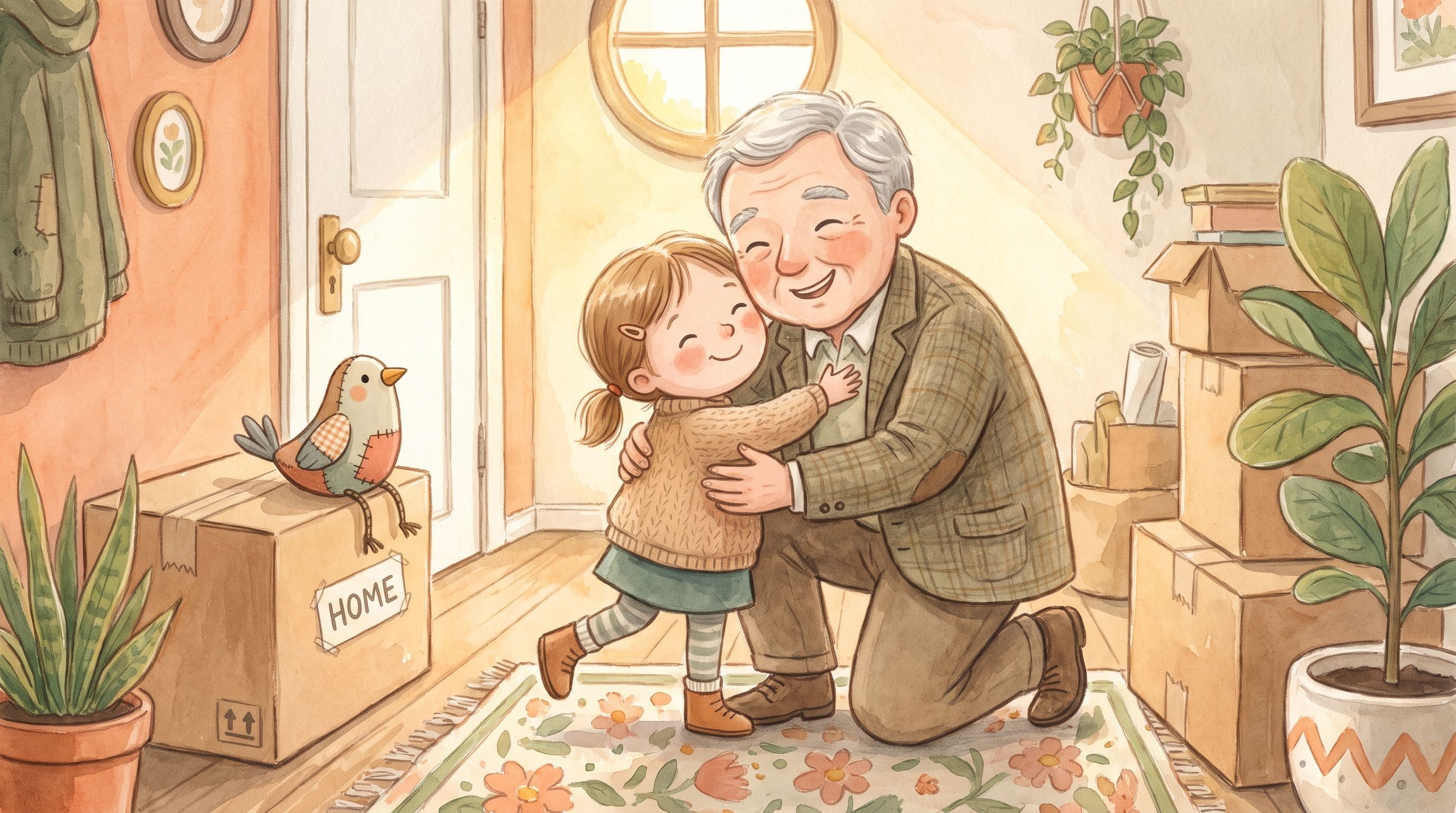
One evening her mom read her a new book with a girl on the cover who had Clara's light brown hair, hugging a grandparent by some moving boxes, and Clara's own name across the top. In the story, that Clara's grandma was moving in too, and her stuffed bird Chirp helped her see the bright side. A grandparent in the house means more love under one roof, more bedtime stories, more helping hands, and someone extra who thinks you hung the moon. Chirp suggested Clara help make grandma's room cozy and pick one special thing to do together, so the change came with something to look forward to.
4. She tries, and feels good
Story-Clara helped set up grandma's room and started a special tradition with her, and the fuller house felt warm and happy. Real Clara wanted to help too. She arranged flowers in grandma's new room and started a morning routine of tea and toast together before school. "This is our special time," Clara decided. The house was busier, but it was cozier too, with grandma's stories and hugs now part of every day.
5. She comes back to the book
Clara asked for the book as grandma settled in, and their tea-and-toast mornings became her favorite part of the day. The adjustment got easier, because Clara had discovered that a fuller house really did mean more love, and a grandma right down the hall was one of the best changes of all.
How should you use a story like this at home?
- Frame the move as more love and help in the house.
- Let your child help make the grandparent's space feel welcoming.
- Start a small shared routine between your child and their grandparent.
- If the grandparent needs care, explain it in gentle, age-appropriate terms, and protect your child's routines where you can.
How do you explain a grandparent moving in because they need care?
Use gentle, age-appropriate language, reassure your child that the grown-ups are taking care of things, welcome their questions and feelings, and keep familiar routines steady. It can help to name the bright side too: the American Academy of Pediatrics notes that a grandparent who lives with the family often becomes an integral part of it, and that when extended families live together there are more adults to look after the children, a built-in support system, and kids who benefit from close contact and love coming from many directions (The "Perfect" Family).
Keep reading: a house that grows by one is a lot like welcoming a new baby — see how this approach helps a child becoming a big sibling.