Story ideas
How do you help a child welcome a new baby sibling?
How to help a child welcome a new baby by reassuring them there's more than enough love and giving them a real big-sibling job, with a full example story.
The short answer
Reassure your child, often and specifically, that there's more than enough love to go around and that yours for them isn't going anywhere, and give them a real, proud big-sibling job so they feel included. Protect one-on-one time after the baby arrives, and welcome their mixed feelings as normal. A story where a character just like them becomes a loving big sibling makes the new arrival feel exciting instead of threatening.
Key takeaways
- A child feels excitement and curiosity, plus a quiet worry: will there still be enough love?
- Those mixed feelings are normal and important.
- Reassure the bond, and give your child a real, proud big-sibling job.
- A story where your child becomes a loving big sibling makes the baby feel exciting, not threatening.
How do you help a child welcome a new baby sibling?
Reassure your child there's more than enough love to go around, and give them a real, proud big-sibling job. A child becoming a big sibling feels a lot at once: excitement, curiosity, and often a quiet worry about what a new baby means for them. Will there still be enough love, enough lap, enough attention? Those worries are normal, and a child who feels secure and included usually welcomes a sibling far more warmly.
Telling a child they'll love the baby doesn't quiet the worry that they'll be replaced. Showing them a future to look forward to does.
Why does a story work when reassurance alone doesn't?
A story lets a child picture themselves on the other side of the change, still loved. When they watch a hero meet the baby, help take care of it, and stay just as loved, the new sibling stops feeling like competition and starts feeling like someone to protect. Give the hero your child's name and face and the pride becomes theirs.
What does a good big-sibling story look like?
The names and characters are invented for this example. In a real personalized book, the hero is your own child.
1. A hero with something big to learn
Oliver's family was about to get bigger. A new baby was coming, and everyone kept saying how exciting it was. Oliver was excited too, mostly. But a small worried part of him wasn't so sure.
2. A worry he can name
Would the baby take all the attention? Would there still be room on his mom's lap for him? Would things ever feel the same? Oliver didn't say these worries out loud, but they sat quietly in his chest.
3. A hero who looks just like him
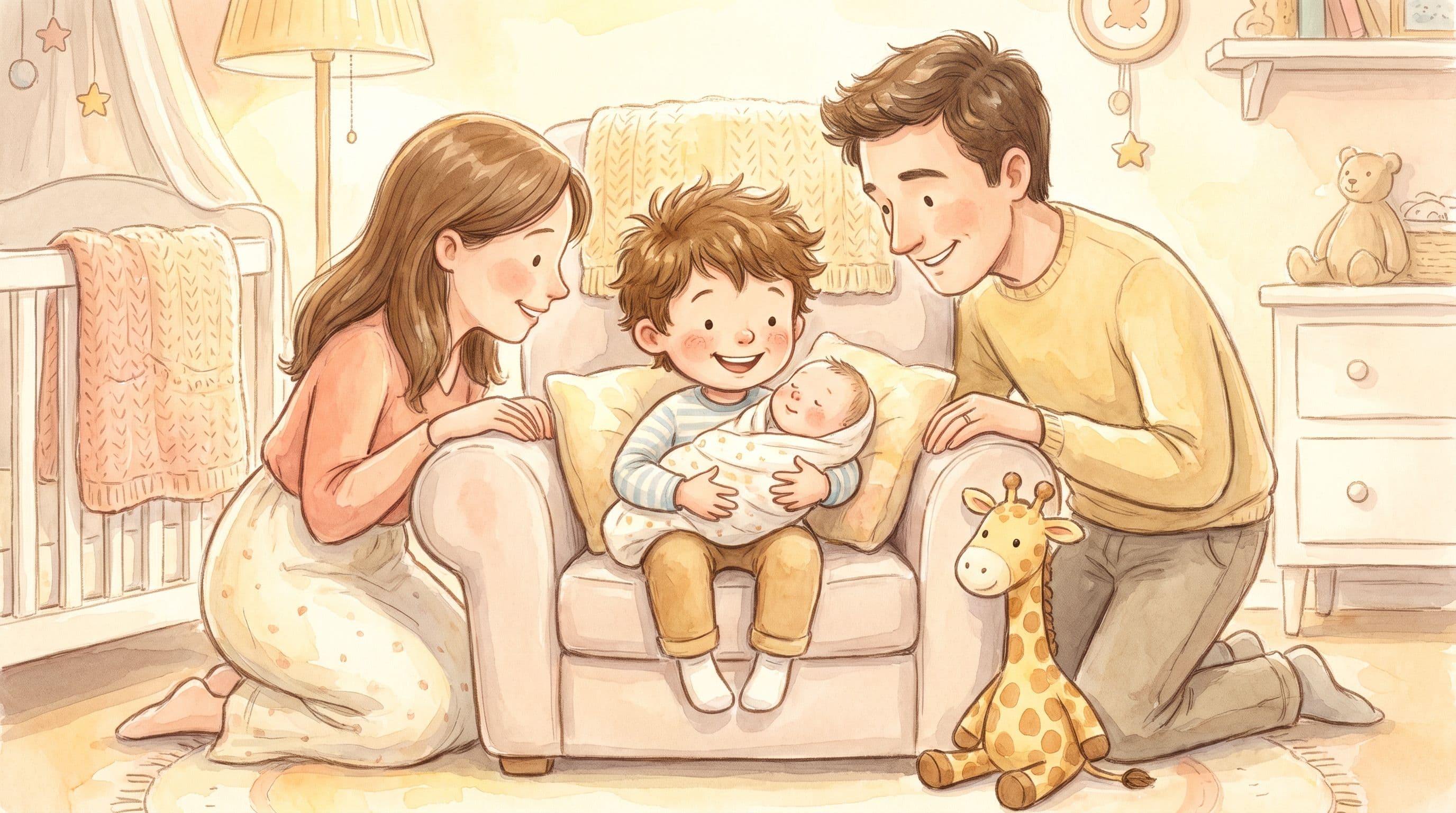
One evening his dad read him a new book with a boy on the cover who had Oliver's brown hair, a tiny baby in his arms, and Oliver's own name across the top. In the story, that Oliver was becoming a big brother too, and his stuffed giraffe Gigi told him the most important secret: love isn't like a cookie you have to split. It's more like a light that just gets brighter with more people to shine on. Story-Oliver learned he had a special big-brother job, helping pick out tiny socks, singing to the baby, being the one who knew how to make it smile. He was still just as loved, and now he was needed too.
4. He tries, and feels proud
Story-Oliver welcomed the baby and discovered his mom's lap still had plenty of room for him. Real Oliver wanted to be a big brother like that. When the baby came, Oliver helped pick out a tiny outfit, sang his favorite song, and was the very first to make it stop crying. His mom pulled him close. "Still my Oliver, always." He grinned. He was a big brother now, and he was good at it.
5. He won't stop asking for the book
Oliver asked for the book again and again, before and after the baby came. He showed the baby the pictures. The worry melted away, because Oliver had learned that a new sibling didn't mean less love. It meant more, plus an important new job that was all his.
How should you use a story like this at home?
- Reassure your child, often and specifically, that your love for them isn't going anywhere.
- Give them a real big-sibling job so they feel included and important.
- Protect one-on-one time with your older child after the baby arrives.
- Welcome all their feelings, including the mixed ones. They're normal.
Is it normal for my older child to feel jealous of the new baby?
Very — some jealousy and mixed feelings are completely normal, and reassurance, inclusion, and one-on-one attention help. The American Academy of Pediatrics suggests engaging older siblings as "special helpers" in age-appropriate ways, being clear about how to treat the baby, and praising them for being good helpers, while expecting occasional outbursts as everyone adjusts (Preparing Your Older Child for a New Baby: How to Help Siblings Adjust).
Keep reading: a new baby often means big-kid changes, like moving to your own room — see how this approach helps a child sleeping through the night in their own room.