Story ideas
How do you help a child learn to tie their shoes without frustration?
How to help a frustrated child learn to tie their shoes by giving them one repeatable method and proof that persistence pays off, with a full example story.
The short answer
Give your child one simple, repeatable method they can chant while they do it, normalize the fumbles as part of learning, and keep practice short and low-pressure. Most children are ready somewhere between ages five and seven, as fine motor skills and sequence memory develop. A story where a character just like them struggles, sticks with it, and finally gets it builds the persistence the skill actually requires.
Key takeaways
- Tying shoes is genuinely hard: fine motor skill, sequence memory, and patience at once.
- The belief that they can get there usually needs help before the skill does.
- Teach one method they can chant, and keep practice short and low-pressure.
- A story where your child struggles and then succeeds reframes fumbling as part of learning.
How do you help a child learn to tie their shoes without frustration?
Give them one simple method they can repeat out loud, treat the fumbles as part of learning rather than proof they can't, and keep sessions short. A child who fails a loop a few times often decides the whole thing is impossible, so the first thing to rebuild is usually the belief, not the technique.
Telling a frustrated child to "just keep trying" rarely lands, because in that moment the failures feel bigger than the encouragement. What helps is a concrete, chantable method and evidence that sticking with it pays off.
Why does a story work when "just keep trying" doesn't?
A story reframes the struggle itself. When a child watches a hero fumble the same loop, feel the same frustration, and then succeed, the message they absorb is that fumbling is part of getting it. Give that hero your child's name and face and the persistence starts to feel like theirs.
What does a good shoe-tying story look like?
The names and characters are invented for this example. In a real personalized book, the hero is your own child.
1. A hero with something big to learn
Sofia could do cartwheels, almost whistle, and read the cereal box. But her shoes had those long laces, and every morning she held them out for a grown-up to tie. She wanted to do it herself. She just couldn't make the loops behave.
2. A worry she can name
Every time she tried, the loops went loose, the bow fell apart, and the whole thing turned into a knot. After a few tries she would drop the shoe and announce, "I can't do it, I'll never do it." Quitting felt easier than failing again.
3. A hero who looks just like her
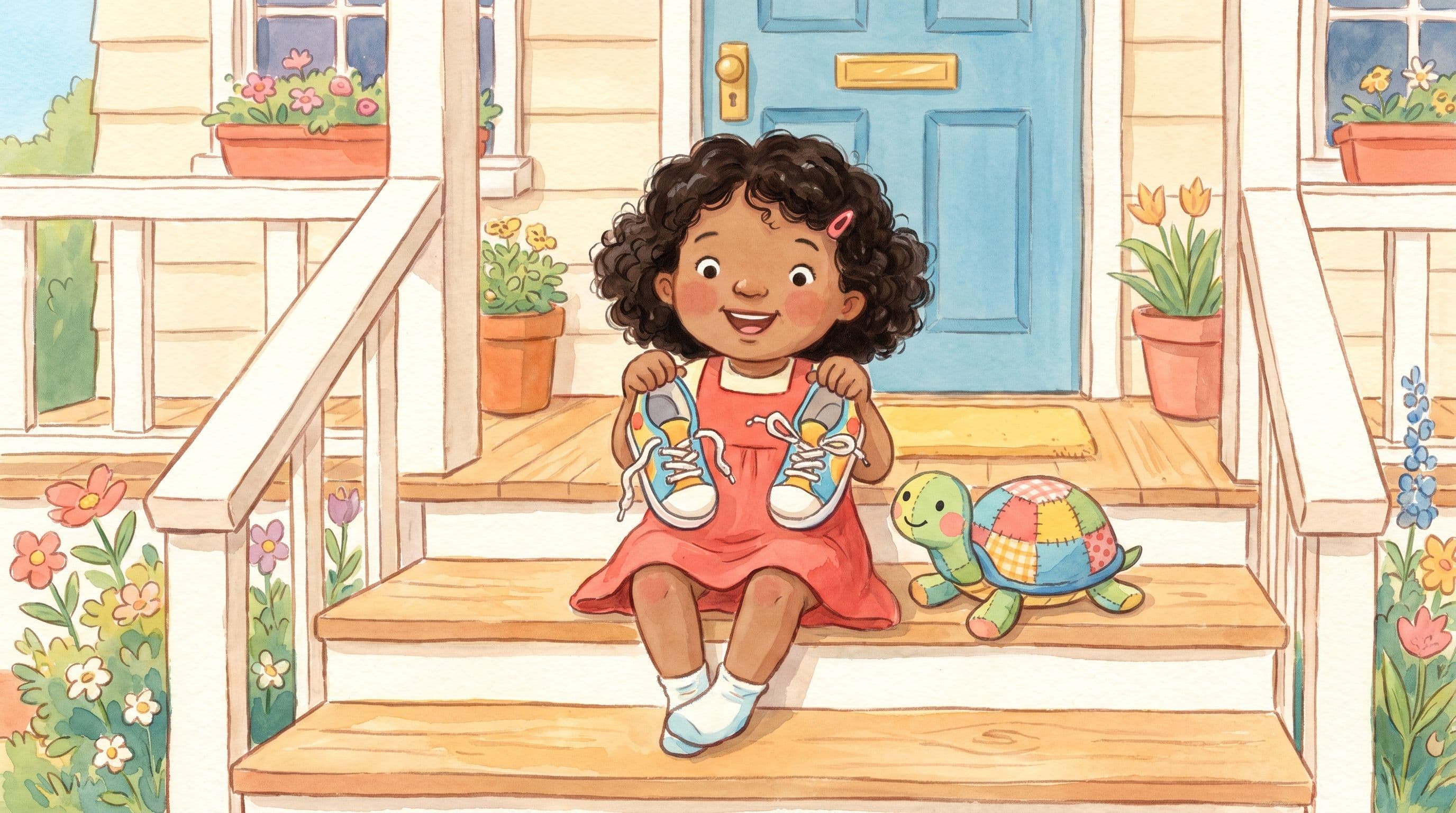
One afternoon her abuela gave her a book with a girl on the cover who had Sofia's dark curls and Sofia's own name on the front. In the story, that Sofia fought with her laces too, until a slow, steady stuffed turtle named Pokey taught her the Bunny Ears: make two loops like rabbit ears, cross them, pull them snug. "Slow is fine," Pokey said. "Slow still gets there."
4. She tries, and feels proud
Story-Sofia practiced slowly, missing a few times, then getting one to hold. Real Sofia grabbed her own sneakers, made her bunny ears, chanted the little rhyme, and pulled. The first bow flopped. The second held. She stared at it, then screamed for the whole house to come see. She had tied her own shoe.
5. She won't stop asking for the book
Sofia asked for the book every night and tied everything she could find: her shoes, her doll's shoes, the drawstring on her backpack. The word "I can't" got a lot quieter around the house, because now she had proof that slow and steady really did get there.
How should you use a story like this at home?
- Practice on a shoe off the foot first, or on a lacing board, where the angle is easier.
- Teach one method and stick with it, so the sequence becomes automatic.
- Praise the effort and the sticking-with-it, not only the finished bow.
- Keep sessions short. Two good tries beat ten frustrated ones.
What age do kids learn to tie their shoes?
There's a wide normal range, so readiness matters more than a birthday. Pediatric milestone guidance notes that four- and five-year-olds typically manage much of their own dressing with only occasional help, while smaller-motor tasks like buttons and shoe-tying are still developing at that age (Developmental Milestones: 4 to 5 Year Olds). Many children put it all together between five and seven, and some a little later, which is exactly why persistence matters more than speed.