Story ideas
What age do kids learn to write their own name?
How to turn wobbly first attempts at writing a name into confident practice, the real ages kids typically start, and a full example story.
The short answer
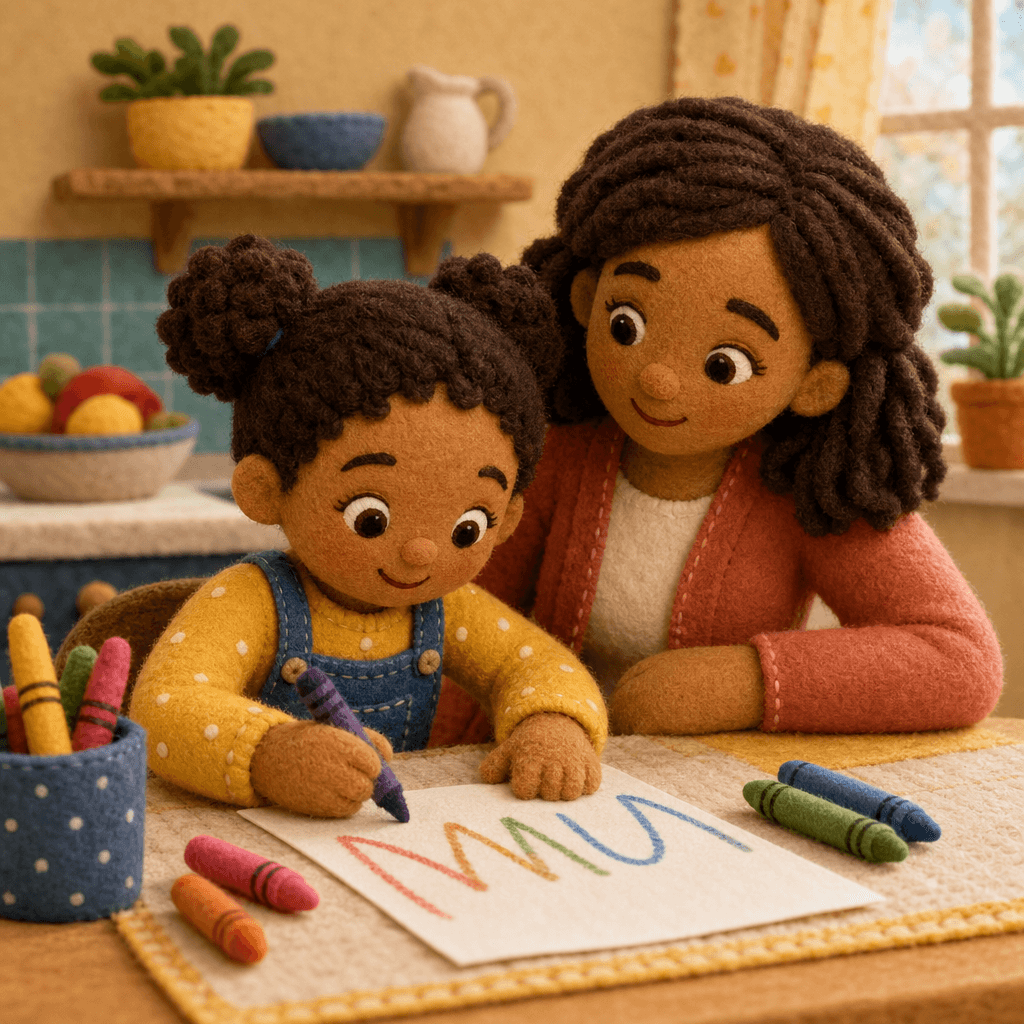
Most children start attempting their own name somewhere between ages three and four, usually with just the first letter, and can print it by age five or six. Handwriting is a fine motor skill built through repetition, not a race, so backwards letters and wobbly lines are normal. A personalized story where a character struggles the same way and keeps practicing turns those wobbly attempts into proof they're getting there.
Key takeaways
- Writing a name is a real fine motor skill, not something a child either "has" or doesn't.
- Most kids start attempting it between ages three and four, and print it clearly by five or six.
- Backwards letters and wobbly lines are normal progress, not something to correct out of a child.
- A story where a character struggles the same way turns practice into pride instead of pressure.
What age do kids learn to write their own name?
Most children start attempting their own name somewhere between ages three and four, usually with just the first letter, and can print the whole thing by five or six (Literacy Milestones: Ages 3-4). The letters in their own name are typically the first ones a child tries to write on purpose, because it's the word that matters most to them.
There's no single "on time." A three-year-old scrawling one recognizable letter and a five-year-old printing the whole name legibly are both right on track.
Why do wobbly or backwards letters happen at first?
Because writing asks a lot of a small hand all at once: remembering the shape, controlling the pencil, and getting the sequence in order. Backwards letters, especially, are extremely common and not a sign anything is wrong — the hand and eye are still learning which way a letter faces.
Fine motor control develops gradually through the preschool years, and skills like printing letters build on it directly (Developmental Milestones: 4 to 5 Year Olds). Pushing for neatness before the hand is ready usually just adds frustration.
What does a good name-writing story look like?
The names and characters are invented for this example. In a real personalized book, the hero is your own child.
1. A hero with something big to learn
Theo could zip his own jacket, count to fifty, and name every dinosaur in his book. But when his teacher asked him to write his name on his cubby tag, all he could manage was a shaky "T" before he gave up.
2. A worry he can name
"My letters look messy," he told his dog Waffle that night, pushing the paper away. "Everyone else's name looks like a real name. Mine looks like a scribble."
3. A hero who looks just like him
For his birthday, his grandma gave him a book with a boy on the cover who had Theo's same gap-toothed smile and Theo's own name printed right on it. In the story, that Theo practiced his letters with a patient old owl named Pip, who taught him to say each letter's shape out loud while he drew it: "Down, curve, down," for the T, the H, the E, the O.
4. He tries, and feels proud
Story-Theo's letters wobbled at first, then steadied, line by line. Real Theo grabbed a crayon, said "down, curve, down" under his breath, and wrote all four letters of his name on a fresh piece of paper. He held it up so Waffle could see. "That's me," he said. "That's really me."
5. He won't stop asking for the book
Theo asked for the story every night and signed his name on everything he could find — drawings, birthday cards, the fridge whiteboard. The messy scribble didn't bother him anymore, because now he had proof that wobbly letters were just letters on their way to steady.
How should you use a story like this at home?
- Start with just the first letter if the whole name feels like too much.
- Say each letter's shape out loud while your child writes it, so the motion has words attached.
- Let backwards or wobbly letters stand. Celebrate the attempt, not the neatness.
- Keep practice to a few minutes. A proud short session beats a frustrated long one.
Does a personalized story really help kids practice?
It gives practice a reason to feel good instead of hard. When a child sees a character who looks like them struggle with the same wobbly letters and keep going, the story does the encouraging so a parent doesn't have to say "try again" for the tenth time. That's often enough to turn a refused worksheet into a name written on purpose.