Story ideas
How do you help a child who is afraid of bugs and spiders?
How to help a child who's afraid of bugs and spiders by replacing panic with curiosity and observing from a safe distance, with a full example story.
The short answer
Replace the fear with curiosity: help your child learn what different bugs do and watch them from a safe, comfortable distance using a tool like a magnifying glass. Start with gentle, familiar bugs, model calm curiosity yourself, and still teach real safety like not touching bees. A story where a character just like them becomes a little bug scientist turns panic into interest.
Key takeaways
- Bugs move fast, appear from nowhere, and behave unpredictably — that's what makes them scary.
- "It won't hurt you" rarely helps, because the fear isn't about logic.
- Curiosity and panic can't easily share the same brain — so grow the curiosity.
- A story where your child becomes a little bug scientist turns fear into interest.
How do you help a child who is afraid of bugs and spiders?
Replace the fear with curiosity. Bugs move fast, appear out of nowhere, and behave in ways a child can't predict, which is exactly what makes them scary. Most of this fear fades as a child learns what bugs actually do — and that shift usually comes from getting interested, not from being told there's nothing to be afraid of.
Telling a scared child a spider won't hurt them rarely lands, because the fear isn't really about logic. Give it somewhere to go instead: a question to ask, a thing to notice, a bug to study from a safe distance.
Why does a story work when "it won't hurt you" doesn't?
A story gives the fear a job. When a child watches a hero get curious about a ladybug or a beetle, they start asking questions instead of running. Give the hero your child's name and face and they become the bug scientist.
What does a good bug-fear story look like?
The names and characters are invented for this example. In a real personalized book, the hero is your own child.
1. A hero with something big to learn
Jack loved being outside, right up until a bug showed up. An ant on the sidewalk, a spider in the corner, a bee near the flowers, and suddenly Jack wanted to be indoors with the doors shut. The bugs were small, but the fear was big.
2. A worry he can name
Bugs moved too fast and popped up out of nowhere, and Jack never knew what they'd do next. That unpredictability made his skin crawl. So he avoided the garden, the grass, and anywhere a bug might be — which was just about everywhere.
3. A hero who looks just like him
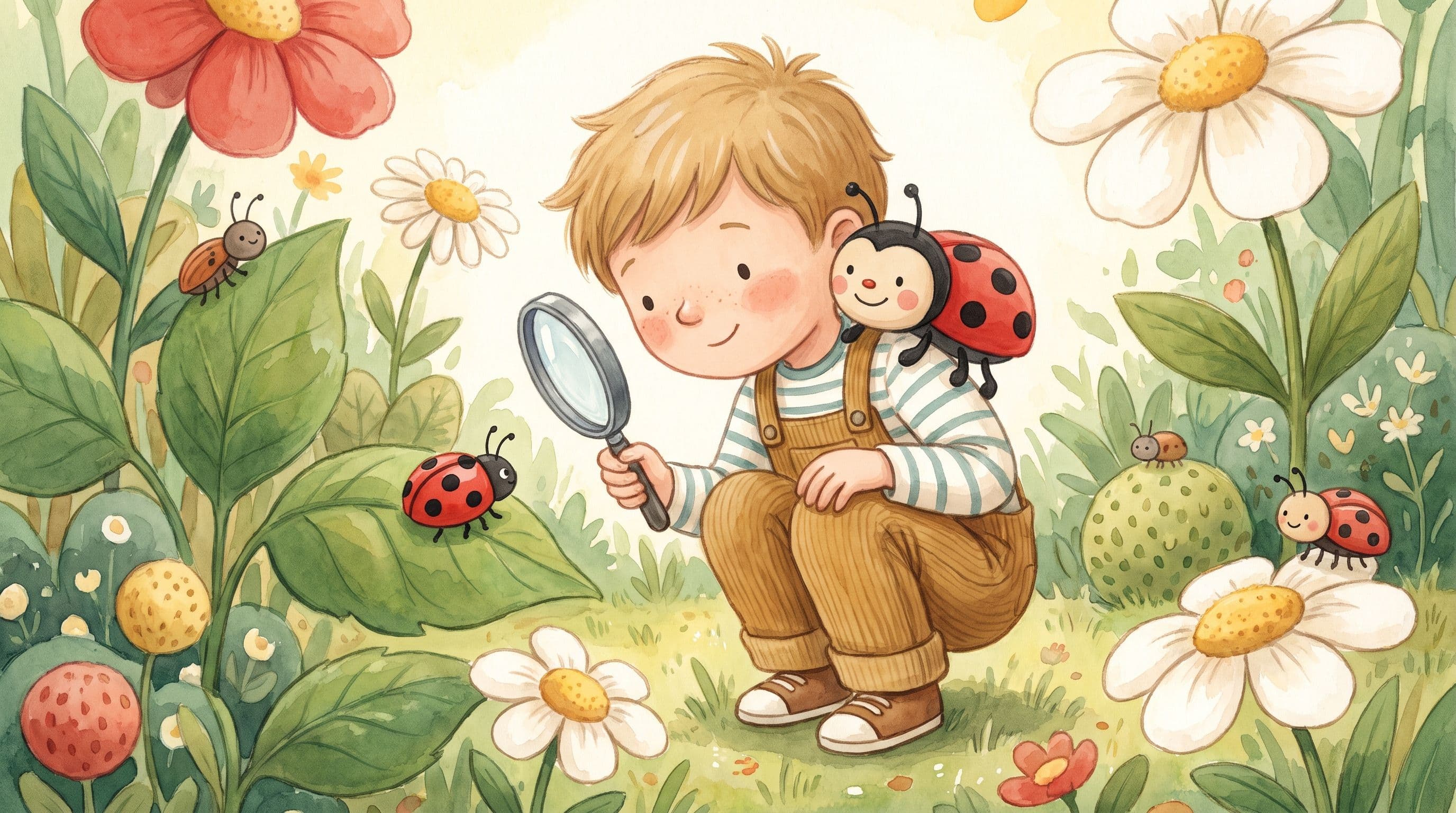
One afternoon Grandpa gave him a new book with a boy on the cover who had Jack's sandy hair and Jack's own name across the top. In the story, that Jack was scared of bugs too, until a cheerful ladybug named Dot invited him to be a Bug Detective. A detective doesn't run, Dot explained. A detective watches from a comfy distance and asks questions: How many legs? What is it doing? Is it a helper, like a ladybug who eats the bugs that hurt the garden?
4. He tries, and feels proud
Story-Jack used a magnifying glass to study bugs from a safe distance and found them more interesting than scary. Real Jack wanted his own Bug Detective kit. Armed with a magnifying glass, he crouched an arm's length from a ladybug and counted its spots. "It eats the bad bugs," he announced, delighted. He watched an ant carry a crumb ten times its size, and didn't run once. He was too busy investigating.
5. He won't stop asking for the book
Jack asked for the book constantly and turned into the family bug expert. He taught Dot's detective questions to his cousin. Bugs stopped ruining his time outside, because now every bug was a case to investigate rather than a reason to head indoors.
How should you use a story like this at home?
- Start with gentle, familiar bugs like ladybugs or roly-polies before anything faster.
- Give a tool that creates distance, like a magnifying glass or a bug-viewing jar.
- Model calm curiosity yourself, since kids borrow your reaction to bugs.
- Still teach real safety, like not touching bees or unknown spiders.
Why is my child so afraid of bugs?
Bugs are fast, small, and unpredictable, which makes them a very common childhood fear, and curiosity plus a bit of knowledge usually shrinks it over time. As with other childhood fears, the American Academy of Pediatrics suggests responding with sympathy and, when your child is calm, gently and gradually building comfort while praising brave behavior, rather than dismissing the fear (Fears & Phobias in Children: How Parents Can Help).
Keep reading: bugs and dogs both catch kids off guard — see how the same approach helps a child afraid of dogs.