Story ideas
How do you help a child who is afraid of costumed characters?
How to help a child scared of mascots and costumed characters by reminding them a friendly person is inside and letting a wave count as hello, with an example story.
The short answer
Remind your child there's a regular, friendly person inside the costume, and let them interact from a comfortable distance, a wave instead of a hug, with no pressure to get closer. Never force contact or a photo, and let a wave count as a full, successful hello. A story where a character just like them meets a mascot on their own terms builds that confidence over time.
Key takeaways
- A mascot is huge, has a face that never changes, moves in a jerky way, and can't talk back.
- To a young child, that's a lot of wrong signals at once — the fear makes sense.
- Remind them a friendly person is inside, and let a wave count as hello.
- A story where your child greets a character on their own terms builds confidence.
How do you help a child who is afraid of costumed characters?
Remind your child there's a regular, friendly person inside the costume, and let them interact from a comfortable distance. A mascot is huge, has a face that never changes, moves in a bouncy, jerky way, and can't talk back. To a young child, that's a lot of confusing signals at once. The goal isn't to force a hug. It's to help your child feel safe and in control near characters, on their own terms.
Nudging a scared child toward a mascot for a photo almost always ends in tears, because it removes the distance they're relying on to feel safe. Keep them in charge and a wave becomes a perfectly good hello.
Why does a story work when pushing them closer doesn't?
A story keeps your child in charge while showing the reassuring fact. When a child watches a hero remember there's a person inside and choose a friendly wave, the character stops being a monster and becomes a costume with a nice person in it. Give the hero your child's name and face and the calm becomes theirs.
What does a good mascot story look like?
The names and characters are invented for this example. In a real personalized book, the hero is your own child.
1. A hero with something big to learn
Leo loved fairs and parties, with one exception. The costumed characters, the giant mascots, the big fuzzy figures waving people over, sent him straight behind a parent's legs. Everyone else wanted a photo. Leo just wanted to keep his distance.
2. A worry he can name
The mascots were so big, and their faces never changed, and they moved in a bouncy, jerky way and couldn't say anything. Leo couldn't tell what they were thinking or what they'd do, and that made his heart race. So he steered clear.
3. A hero who looks just like him
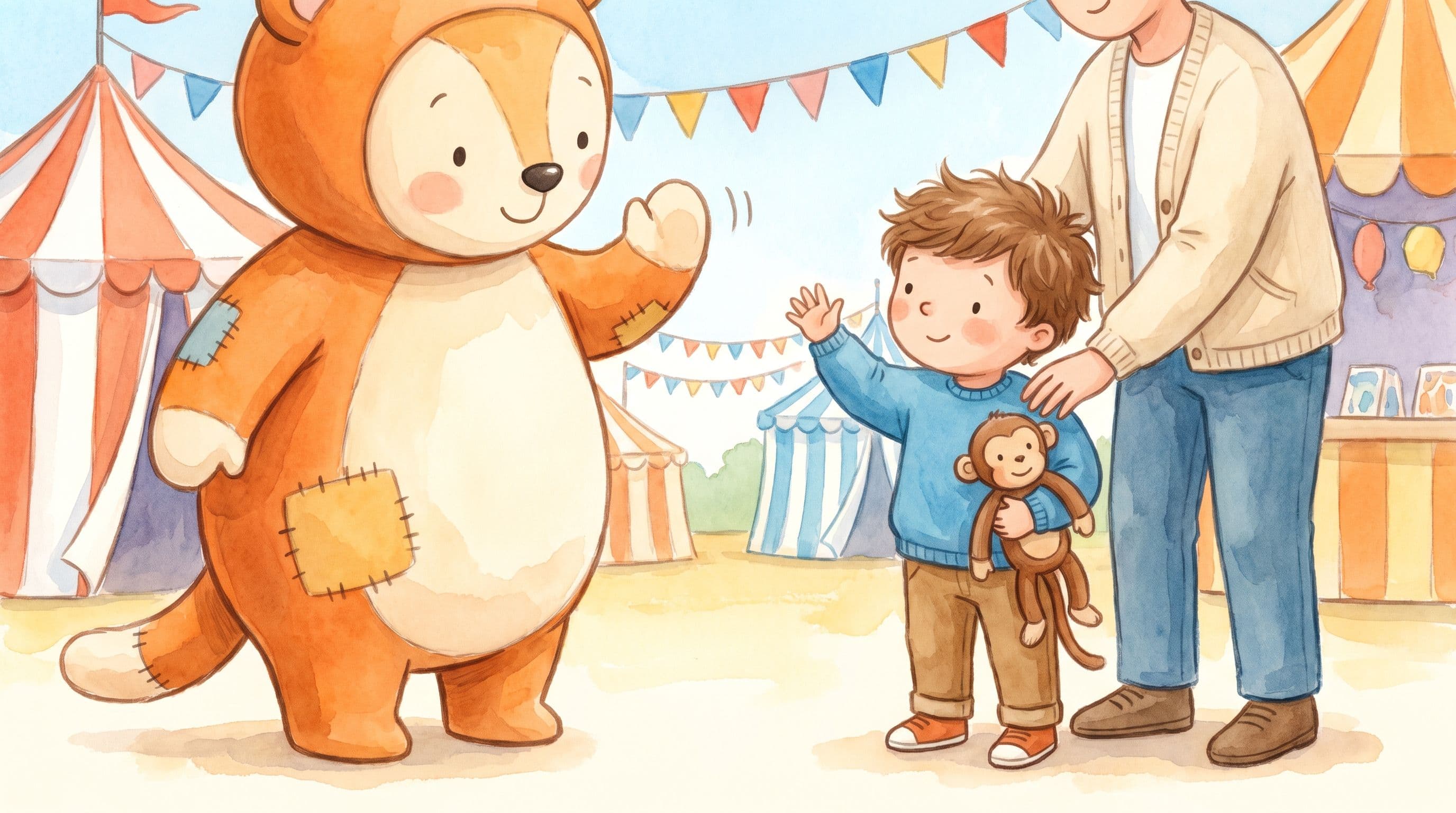
Before a trip to the fair, Dad read Leo a new book with a boy on the cover who had Leo's brown hair and Leo's own name across the top. In the story, that Leo was scared of mascots too, until his stuffed monkey Mango shared the secret: inside every costume is a regular, friendly person, someone's mom or big brother, waving hello just like a person waves. And you never have to hug a character. A wave from wherever you're comfortable is a perfectly good hello.
4. He tries, and feels proud
Story-Leo waved to a big friendly fox mascot from a comfortable distance, and the fox waved back, and it felt fine. Real Leo wanted to try. At the fair, a big fuzzy mascot waved from across the way. Leo held Dad's hand, remembered the friendly person inside, and lifted his hand in a small wave. The mascot waved back with a happy bounce. Leo grinned and waved again, a little bigger. He never got closer than he wanted, and that was exactly the point.
5. He won't stop asking for the book
Leo asked for the book before every party and fair, and waving to characters from a comfy distance became his thing. He explained the person-inside secret to a nervous friend. Mascots stopped ruining the fun, because Leo had a way to say hello that kept him feeling safe and in control.
How should you use a story like this at home?
- Never force contact or a photo. Let a wave count as a full, successful hello.
- Let your child control the distance and approach only if and when they want.
- Point out the friendly person inside so the character feels less mysterious.
- Celebrate the wave as the win. Getting closer can come later, or not at all.
Why is my child scared of mascots and costumed characters?
Mascots are large, have unchanging faces, move unpredictably, and can't speak, which sends confusing signals to a young child; it's a very common fear that usually eases with time and low-pressure exposure. That gradual, no-pressure approach lines up with the American Academy of Pediatrics' guidance on childhood fears: respond with sympathy, avoid forcing the feared situation, and gently build comfort while praising brave behavior (Fears & Phobias in Children: How Parents Can Help).
Keep reading: a mascot bounding over and a dog running up trigger the same startled feeling — see how this approach helps a child afraid of dogs.