Story ideas
How do you help a child cope with a parent's deployment?
How to help a child through a parent's deployment with concrete ways to stay connected, a visible countdown, and the steady message that love reaches across the miles.
The short answer
Give your child tangible ways to stay connected, video calls, letters, drawings, and a matching keepsake, plus a countdown they can mark each day so the wait feels visible and shrinking. Welcome the sad and missing feelings by name, keep the deployed parent present in daily talk, and lean on military family support programs or a counselor if needed. A story where a character just like them stays close to a faraway parent makes the distance feel bridgeable.
Key takeaways
- A deployment means a long stretch of missing someone a child loves every day.
- Young children measure time differently, so a long wait can feel endless.
- Make connection concrete, make the wait visible, and affirm that love crosses the distance.
- A story where your child stays close to a faraway parent makes the distance feel bridgeable.
How do you help a child cope with a parent's deployment?
Give your child tangible ways to stay connected, a countdown they can track, and the steady message that their parent's love is with them every day. When a parent is deploying, a child faces a long stretch of missing someone they love — they may only know that a person they need won't be tucking them in for a while. A deployment is hard on the whole family, and what helps a child most is concrete connection and the certainty that the love reaches all the way across the distance.
A long deployment can feel endless to a child who measures time differently than adults. Making the wait visible changes that.
Why does a story work when the distance feels endless?
A story makes the connection concrete and the wait visible. When a child watches a hero send letters, wave on video calls, hug a matching keepsake, and mark off the days, the distance stops feeling like a void and becomes something they can bridge, day by day. Give the hero your child's name and face and the connection becomes theirs.
What does a good deployment story look like?
The names and characters are invented for this example. In a real personalized book, the hero is your own child.
1. A hero with something big to face
Sadie's parent had to go away for a long time for their job, far from home. Sadie knew they loved her and would come back, but a long time felt like forever to her, and she was going to miss them so much.
2. A worry she can name
Who would do their special handshake at bedtime? Would her parent still feel close, so far away? The stretch of days ahead felt endless, and the missing sat heavy in Sadie's heart.
3. A hero who looks just like her
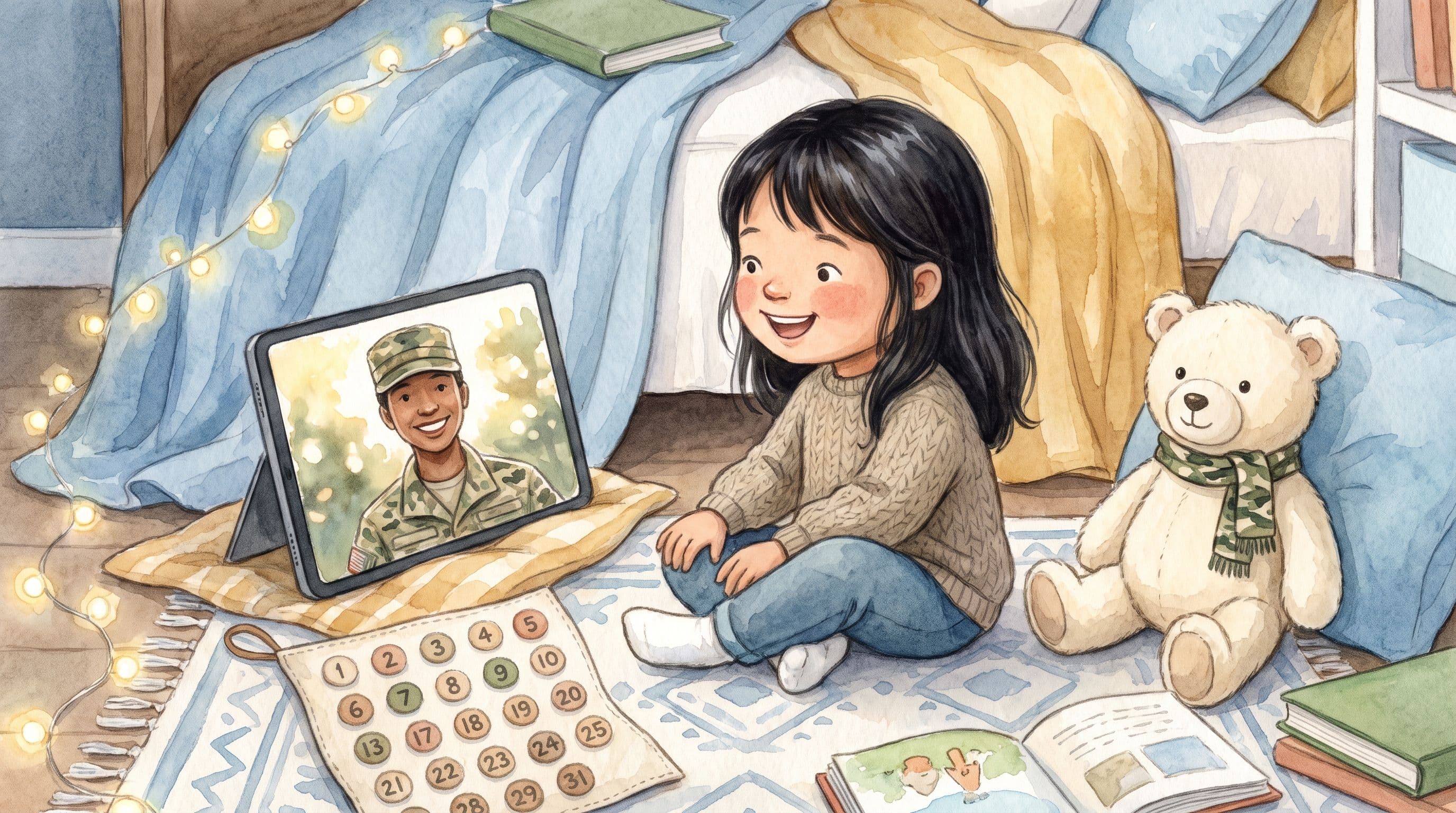
One evening, her grown-up at home read her a new book with a girl on the cover who had Sadie's dark hair, waving at a tablet, and Sadie's own name across the top. In the story, that Sadie had a parent far away too, and she had a whole toolkit to stay close: a calendar to color a square each day so she could see the wait getting shorter, video calls to share her day and blow goodnight kisses, letters and drawings to send back and forth, and a matching teddy bear, one for her and one for her parent, so they were always hugging the same thing. Her bear Comet reminded her that love isn't stopped by distance. It reaches as far as it needs to.
4. She tries, and feels close
Story-Sadie used her toolkit and felt her parent's love every single day, even from far away. Real Sadie wanted to stay close like that too. She colored in her countdown calendar each morning, waved and told stories on video calls, mailed drawings, and hugged her matching bear at night knowing her parent was hugging one just the same. "We're hugging the same bear right now," she'd whisper. The distance was still hard, but the love came through loud and clear.
5. She comes back to the book
Sadie asked for the book all through the deployment, especially on the days that felt long. She showed her countdown calendar to anyone who'd look. The missing didn't disappear, but underneath it was something steady: her parent's love reached all the way to her, every day, and the wait was slowly shrinking toward a homecoming.
How should you use a story like this at home?
- Set up a countdown your child can mark each day, so time feels visible and shrinking.
- Keep connection concrete with regular calls, letters, drawings, and a matching keepsake.
- Welcome the sad and missing feelings, and name them together.
- Lean on military family support programs and, if needed, a counselor experienced with deployment.
How do you help a child feel connected to a deployed parent?
Use regular video calls, letters and drawings, and a matching keepsake like paired bears, and keep the deployed parent present in daily conversation. The American Academy of Pediatrics notes that children respond to deployment differently by age and show real resilience when supported, that fostering closeness through visits, phone calls, and messages helps children feel secure, and that if a child's stress remains or increases after the parent returns, individual or family counseling can help (Effects of Deployment on Children & Families).
Keep reading: a deployment and a job that keeps a parent on the road share the same ache — see how this approach helps a child with a parent who travels for work.