Story ideas
How do you help a child with sensory overload in busy, noisy places?
How to help a sensory-sensitive child in overwhelming places by validating the overwhelm and giving them tools, ear protection, a calm-down spot, and a way to ask for a break.
The short answer
Validate that the overwhelm is real and not misbehavior, and give your child tools, ear protection, sunglasses, a calm-down spot, or a break, plus a signal they can use to ask for help before they reach a breaking point. Build a calm-down kit together, and if overwhelm is frequent or intense, an occupational therapist or pediatrician can help. A story where a character just like them uses their tools to stay calm builds real self-regulation.
Key takeaways
- Too much noise, too many people, or too-bright lights can overwhelm a sensory-sensitive child.
- These children aren't misbehaving; they're overwhelmed, their nervous system on overload.
- Validate the overwhelm, and give them concrete tools and a way to ask for a break.
- A story where your child uses their tools to stay calm builds real self-regulation.
How do you help a child with sensory overload in busy, noisy places?
Validate that the overwhelm is real, and give them tools, ear protection, sunglasses, a calm-down spot, or a break, plus a way to ask for help before they reach a breaking point. When it's too much noise, too many people, too bright, some children become overwhelmed in a way that can look like a meltdown but is really their nervous system on overload. A story can validate that and hand them tools to feel calm and in control.
An overwhelmed child can't reason their way calm in the moment. A story teaches the tools ahead of time and validates the experience.
Why does a story work when the world is too much?
A story teaches the tools ahead of time and validates the experience. When a child watches a hero feel overwhelmed, use their sensory tools, and take a break, they learn that the overwhelm is real, manageable, and nothing to be ashamed of. Give the hero your child's name and face and the control becomes theirs.
What does a good sensory-overload story look like?
The names and characters are invented for this example. In a real personalized book, the hero is your own child.
1. A hero with something hard
Sena felt things strongly. In busy, loud, bright places, the store, a party, a big gym, it all became too much: too many sounds at once, too many people, lights too bright. Her body would feel like it was buzzing, and she didn't know how to make it stop.
2. A worry she can name
When the world got to be too much, Sena felt like she might burst. Sometimes it came out as tears or needing to run away, and she worried something was wrong with her. Really, her senses were just taking in more than they could hold.
3. A hero who looks just like her
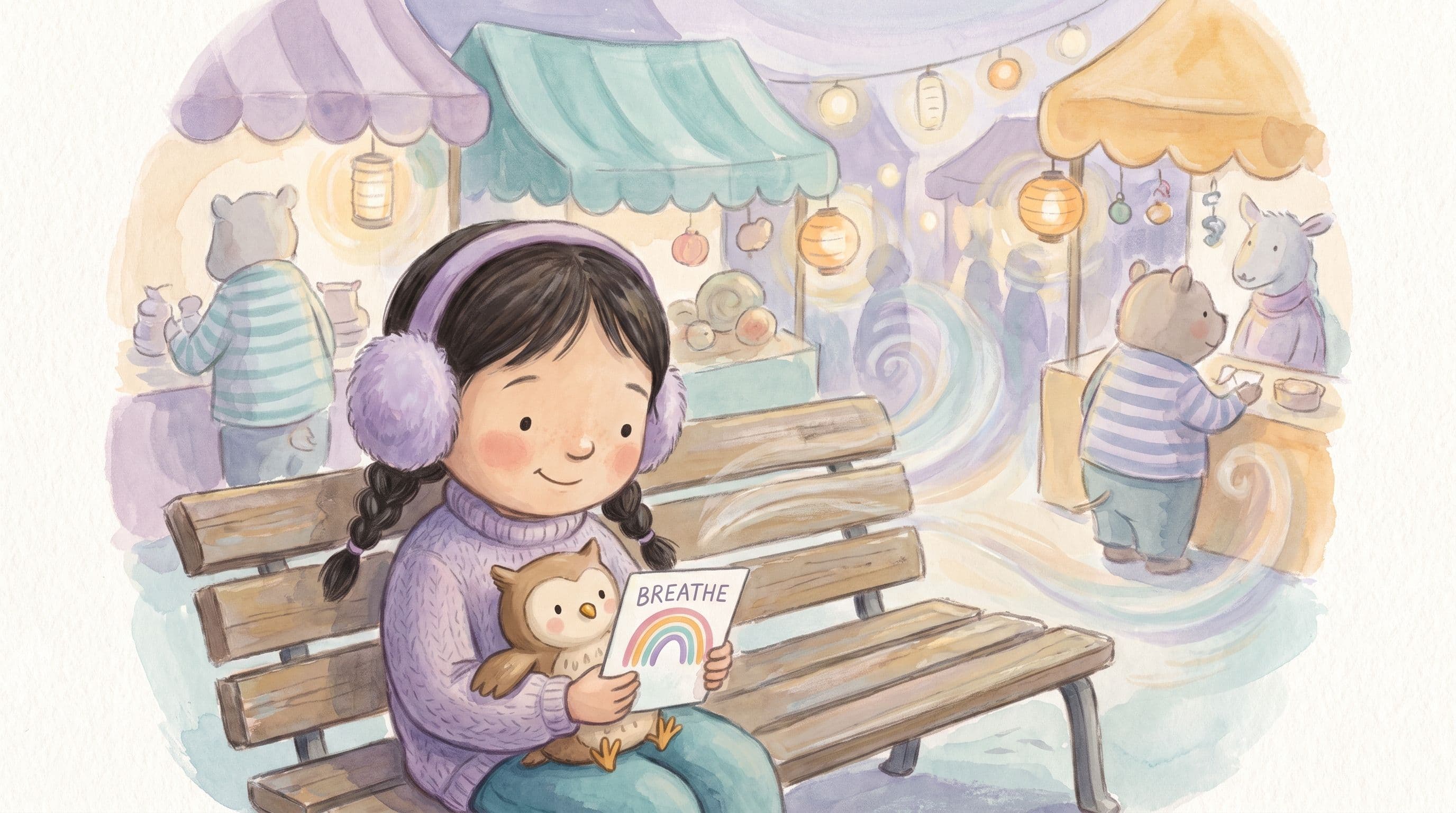
One evening her mom read her a new book with a girl on the cover who had Sena's dark hair, calm in a busy place with her headphones, and Sena's own name across the top. In the story, that Sena got overwhelmed too, and her gentle stuffed owl Hush helped her understand. There's nothing wrong with you, Hush said, your senses just work extra-strong, and that means busy places can feel like too much. So we make a Calm-Down Kit: ear protection to soften loud sounds, sunglasses or a hat for bright lights, a squeeze toy, and a plan to find a quiet calm-down spot for a break. Best of all, Hush taught her a way to ask for help early: a signal to a grown-up that means "I need a break," before things become too much. Story-Sena used her kit and her signal, took a break when she needed it, and stayed calm.
4. She tries, and feels in control
Story-Sena's Calm-Down Kit helped her handle the busy world. Real Sena wanted her own kit. She and her mom packed ear protection, sunglasses, and a squeeze toy, and made a hand signal that meant "I need a break." At a loud birthday party, Sena felt the buzzing start, put on her ear protection, gave her mom the signal, and took a few minutes in a quiet room. Then she rejoined, calm. She hadn't melted down. She'd used her tools. "I took care of my body," she said, proud.
5. She comes back to the book
Sena asked for the book before big outings, and Hush's Calm-Down Kit went everywhere with her. Overwhelming places got more manageable, because Sena had learned that her strong senses are just part of how she's made, and she has tools and a voice to take care of herself.
How should you use a story like this at home?
- Validate that sensory overwhelm is real and not misbehavior.
- Build a Calm-Down Kit with tools your child finds helpful.
- Create a signal or word your child can use to ask for a break early.
- If sensory overwhelm is frequent or intense, an occupational therapist or your pediatrician can offer support and strategies.
Is sensory sensitivity related to autism?
Sensory sensitivities are common in autistic children and also occur in many non-autistic kids. The American Academy of Pediatrics notes that some children are hypersensitive to stimuli, so loud sounds or bright lights that don't bother others can cause real discomfort, and that calming strategies, environmental adjustments, breaks, and, when helpful, support from an occupational therapist can make busy environments more manageable (Sensory Integration Therapy).
Keep reading: understanding your senses and understanding your brain go together — see how this approach helps a child understanding their autism.