Story ideas
How do you help a child feel proud of using a wheelchair, walker, or prosthetic?
How to support a child who uses mobility equipment by framing it as a cool tool, celebrating their abilities, giving a confident answer for questions, and championing inclusion.
The short answer
Frame the equipment as a cool tool that helps your child do what they want to do, let them personalize it, and celebrate everything they can do. Give them a confident, simple answer for curious questions, like "These are my wheels, they help me get around," and champion their full inclusion so everyone plays together. A story that centers them as a capable, proud hero, playing, belonging, and leading, builds real confidence.
Key takeaways
- A child who uses mobility equipment navigates a world that isn't always built for them.
- They may field curious questions or feel left out of certain activities.
- Frame the equipment as a cool tool, celebrate their abilities, and champion inclusion.
- A story that centers them as a capable, proud hero builds real confidence.
How do you help a child feel proud of using a wheelchair, walker, or prosthetic?
Frame their equipment as a cool tool that helps them do what they want to do, celebrate their abilities, give them a confident answer for questions, and champion their full inclusion. If your child uses a wheelchair, walker, or prosthetic, they're capable, whole, and worthy exactly as they are. Helping them feel proud of themselves and their equipment gives them a strong foundation of self-worth.
Kids who use mobility equipment rarely see themselves as the celebrated hero of a story. A story fixes that.
Why does a story work?
A story makes the child the celebrated hero. When a child sees a hero like them play, belong, and lead, their wheelchair or prosthetic framed as an awesome tool, they absorb the truth that they are capable and whole, and their equipment is part of what helps them shine. Give the hero your child's name and face and the pride becomes theirs.
What does a good story look like?
The names and characters are invented for this example, and the story can be adapted for a walker, prosthetic, or other equipment. In a real personalized book, the hero is your own child.
1. A hero with his own way of getting around
Jae used a wheelchair to get around, and he was fast and capable in it. But sometimes kids asked lots of questions, or certain activities weren't set up for him to join, and Jae could feel left out or unsure how to respond.
2. What he wants
Jae wished he always felt like part of the group, and he wasn't sure what to say when kids were curious about his chair. He wanted to feel proud, not singled out.
3. A hero who looks just like him
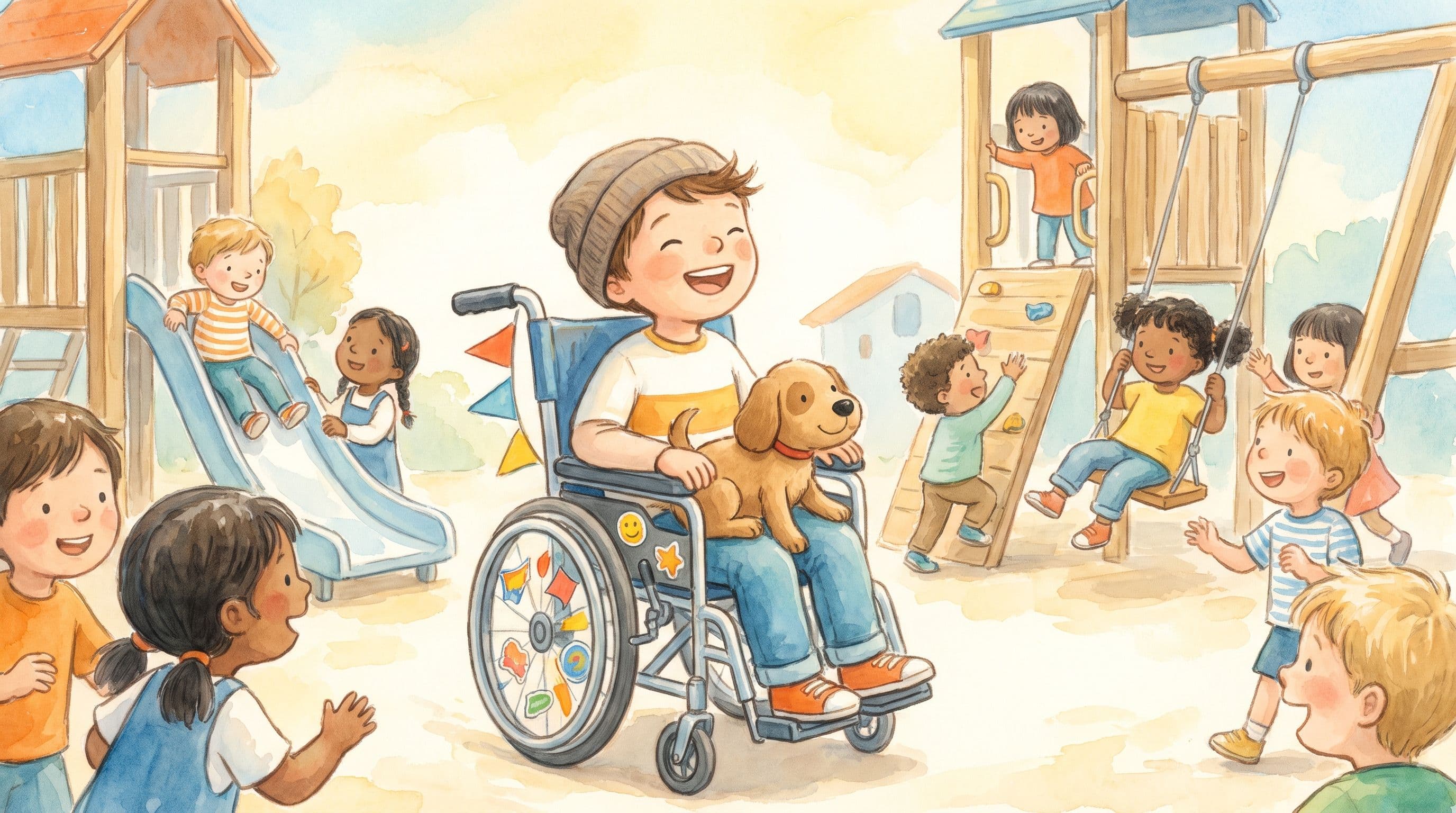
One evening his dad read him a new book with a boy on the cover who had Jae's smile in a bright, decorated wheelchair, playing with friends, and Jae's own name across the top. In the story, that Jae used a wheelchair too, and his stuffed dog Rolly called it his Awesome Wheels, a cool tool that helped him zoom, spin, and do the things he loved. When kids were curious, Rolly said, you can answer with a proud, simple line: "These are my wheels, they help me get around, want to see how fast I can go?" And when an activity wasn't set up for him, the answer was to find a way to include everyone, because Jae belonged in the fun. Story-Jae raced his friends, led a game, and shone.
4. He plays, belongs, and leads
Story-Jae felt proud and fully included. Real Jae wanted that too. He decorated his chair to make it his own, practiced his confident line, and when kids asked, he showed off how fast he could zoom. When a game wasn't set up for him, he and his friends found a way for everyone to play. Jae led a race and won, laughing. He felt capable, proud, and right in the middle of the fun, exactly where he belonged.
5. He comes back to the book
Jae asked for the book again and again, because it showed him as the capable, proud hero he is. He grew up confident in himself and his Awesome Wheels, knowing his equipment is a cool tool that helps him do what he loves, and that he belongs everywhere.
How should you use a story like this at home?
- Frame mobility equipment as a helpful, cool tool, and let your child personalize it.
- Celebrate everything your child can do.
- Give them a confident, simple answer for curious questions.
- Advocate for full inclusion, and find ways for everyone to play together.
What should a child say when kids ask about their equipment?
A proud, simple line works well, like "These are my wheels, they help me get around," and practicing it builds confidence. The American Academy of Pediatrics emphasizes that children with disabilities benefit greatly from being fully included in play and physical activity, that adaptations and support networks help them build confidence in their abilities, and that inclusion lets every child participate, belong, and thrive alongside their peers (Physical Activity for Children and Teens with Disabilities: AAP Policy Explained).
Keep reading: pride in who you are is the throughline — see how this approach helps a child who's much smaller or taller than everyone.