Story ideas
How do you help a child who's scared to put their face in the water?
How to help a water-shy child learn to put their face in the water, by building up in tiny playful steps, with a full example story.
The short answer
Build up in tiny steps, starting with blowing bubbles and getting the chin wet, so the face-in moment arrives after your child already feels safe. Move only as fast as they're ready, keep it playful, and never force it. Swim skills are separate from water safety, which always needs supervision and life jackets. A story where a character just like them takes those small steps makes the first bubble feel exciting instead of scary.
Key takeaways
- Getting the face wet means giving up control for a second; the unknown is the scary part.
- Build up in tiny steps so the face-in moment comes last, after safety is built.
- Keep it playful, move at your child's pace, and never force it.
- A story where your child blows the first bubble makes the water feel friendly.
How do you help a child who's scared to put their face in the water?
Build up in tiny steps, starting with blowing bubbles and getting the chin wet, so the face-in moment arrives only after your child already feels safe. For a cautious kid, putting their face in means they can't see or breathe for a second, and that second feels very long. The fear is normal and it passes, usually through small, playful wins rather than being coaxed.
Coaxing tends to make a scared child cling harder, because it asks them to be brave before they feel safe. Flip the order: build the safety first, and the bravery follows.
Why does a story work when coaxing doesn't?
A story lets your child watch a hero blow the first bubble and love it, so the water stops looking like a threat and starts looking like a place where fun happens. Give the hero your child's name and face and they start cheering for their own first splash.
What does a good learning-to-swim story look like?
The names and characters are invented for this example. In a real personalized book, the hero is your own child.
1. A hero with something big to learn
Zoe loved the pool, as long as the water stayed below her chin. She splashed on the steps and kicked at the edge, but the moment anyone mentioned putting her face in, she was done. It felt like too much all at once.
2. A worry she can name
Putting her face in meant she couldn't see, couldn't breathe for a second, and didn't know what would happen. That unknown was the scary part, so she kept her chin high and her face dry, and swim lessons felt stuck.
3. A hero who looks just like her
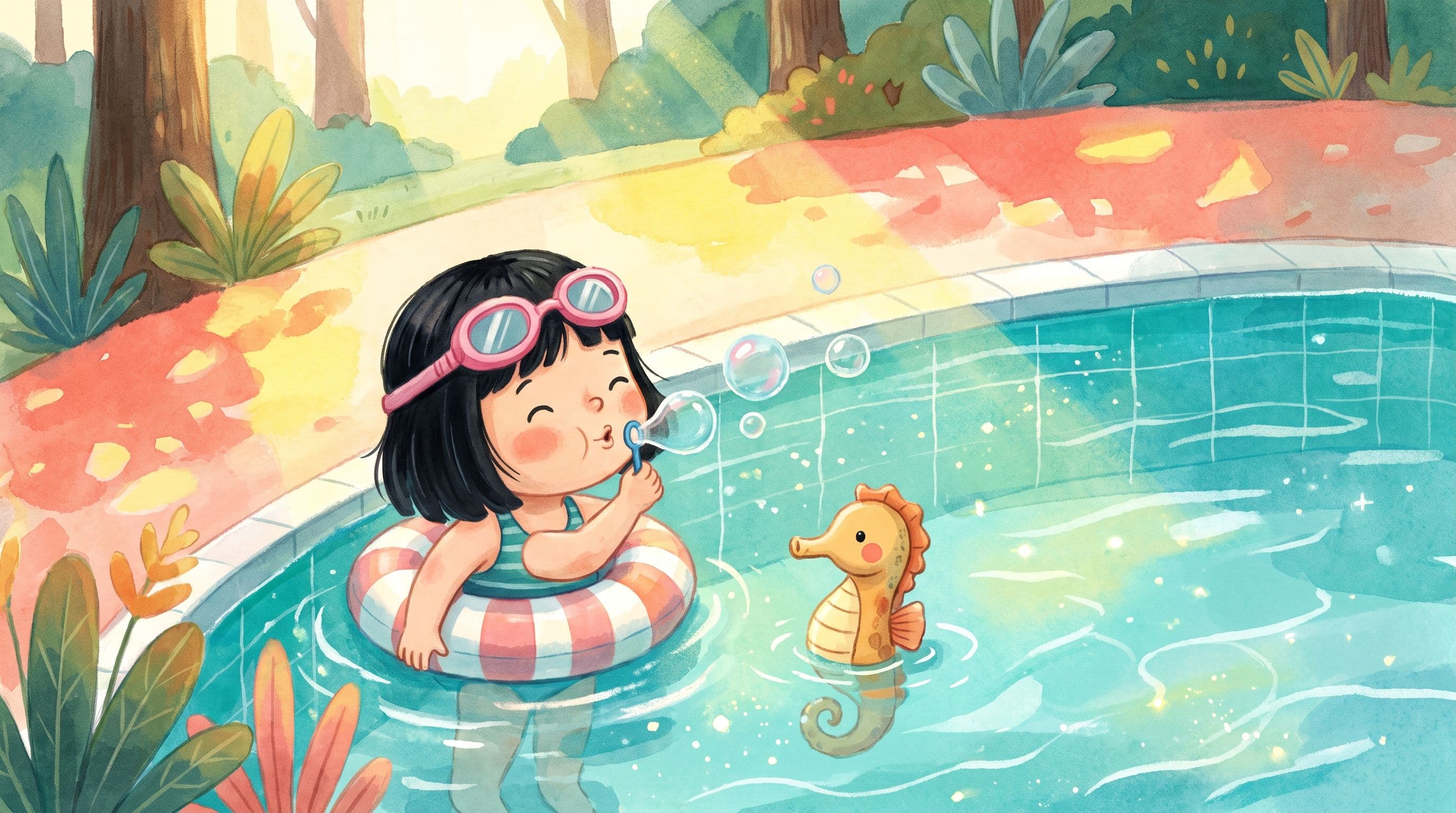
One evening Mom read her a new book with a girl on the cover who had Zoe's short dark hair and Zoe's own name across the top. In the story, that Zoe was scared too, until a friendly seahorse named Bubbles showed her the secret: you don't jump to the scary part. You start by blowing bubbles, then dipping your chin, then your lips, then, only when you're ready, one quick dip of your whole face. One little step at a time.
4. She tries, and feels proud
Story-Zoe got braver step by step and finally dipped her face for one whole second. Real Zoe wanted to try. At her next lesson she blew bubbles, got her chin wet, then her lips, and when she was ready she counted one-two-face and dipped. She came up gasping and grinning. "I did it! I put my face in!" She did it again just to prove it wasn't an accident.
5. She won't stop asking for the book
Zoe asked for the book before every swim day and practiced her bubbles in the bathtub. She taught the seahorse steps to a friend at the pool. The water stopped being scary, because now she had a plan for it, one small step at a time.
How should you use a story like this at home?
- Practice bubbles in the bathtub, where it's familiar and low-pressure.
- Move only as fast as your child is ready — one small step per session.
- Keep swim skills separate from safety: supervision and life jackets matter regardless of comfort.
- Celebrate each small step, not just the full face-in.
Why is my child scared to put their face in the water?
For most kids it's the loss of control and the unknown rather than the water itself, and building up in small steps usually resolves it. Keep the bigger picture in mind, too: the American Academy of Pediatrics notes that swim lessons can begin for many children around age one, but that swimming ability is only one layer of protection and never replaces close supervision, barriers, and life jackets (Swim Lessons for Children: When to Start & What to Consider).
Keep reading: the pool is one first-time leap; the bus is another — see how the same approach helps a child nervous to ride the school bus.